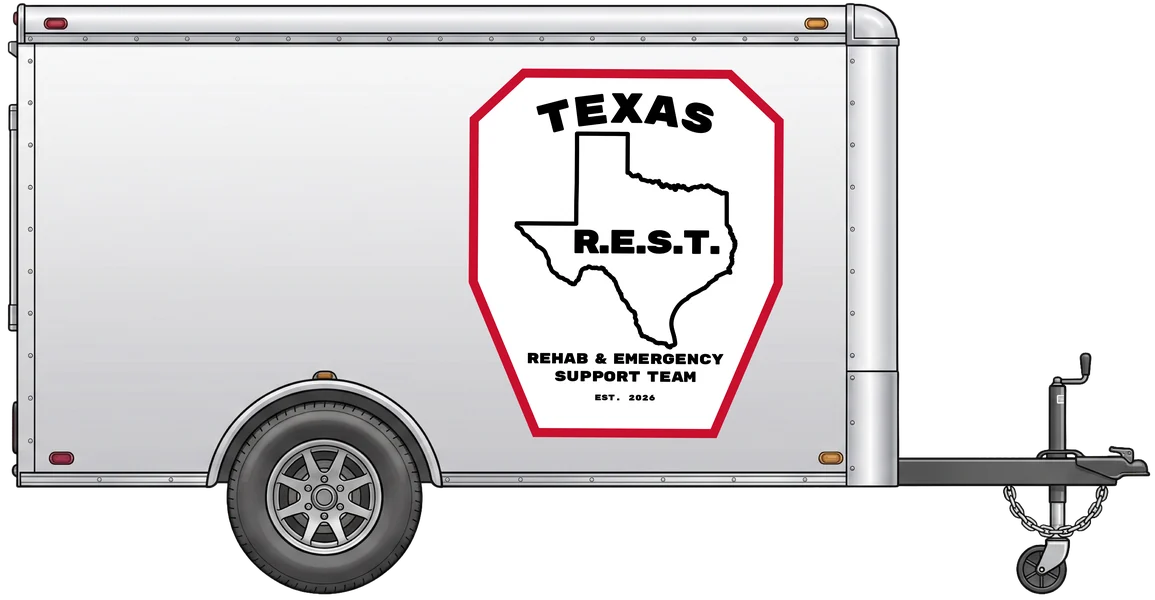
TRAILER · 5×8 CARGOIn upfit
5×8 Cargo Trailer
- 5×8 enclosed cargo trailer
- Interior upfit in progress
Texas R.E.S.T. started with a group of friends who are also career first responders who kept running into the same gap from the inside.
On the largest incidents, resources arrive at scale, from the county’s Office of Emergency Management to regional assets from agencies like SETRAC. Large-scale logistics show up because the scale demands it.
But most calls never reach that threshold. The two-alarm fire that runs four hours, the crime scene that holds overnight, the search that stretches a shift to its limit. These incidents are too big for crews to sustain on their own, but too small to trigger a regional response, so rehab on them falls to whoever happens to be available, if anyone.
We watched that gap from the working end of it for years, so we did something about it. In early 2026, we took the formal steps to stand up a Texas non-profit, built the governance and operating framework behind it, and put a dedicated rehab capability on the map for the calls that fall in between.
We’re new, and we’re honest about that. We’re just getting started. But we built this based on the same reasons we became first responders: to serve our community, and in this case for the responders within them.
“Rehab”, short for rehabilitation, is the process of cycling responders off the front line during a long or punishing incident so they can recover before they go back in. That recovery includes water and electrolytes, food, cooling or warming, rest, and a medical check. Rehab is how responders avoid collapsing on a scene, so they can continue to get the job done.
The work is brutal on the body in ways the public rarely sees. We all know the heat in Texas is no joke. Dehydration sets in fast under heavy gear and the heart takes a beating. Firefighting makes up only a small share of a responder’s on-duty hours, yet roughly half of firefighter line-of-duty deaths happen on scene, and sudden cardiac events are the single leading cause. Structured rehab exists to catch those problems early, before a tired responder becomes a casualty.
Feeding and watering responders on a scene is an old tradition. Canteen units have rolled coffee, food, and relief to firefighters and disaster crews for the better part of a century. What changed is that “make them comfortable” grew into a defined, medical process.
The U.S. Fire Administration formalized it first, publishing Emergency Incident Rehabilitation in 1992. The National Fire Protection Association then turned it into a recognized standard: NFPA 1584 began as a Recommended Practice in 2003 and was elevated to a full Standard in 2008. That 2008 upgrade is where the medical side entered the picture, with baseline vital signs, pulse oximetry, and carbon-monoxide screening for crews coming off the fire. The standard has been revised since, most recently in 2022.
Today, rehab is two functions working side by side.
EMS assessment, including vitals, CO and oxygen screening, and cardiac monitoring like a 12-lead EKG where local protocol calls for it.
Everything else that makes recovery physically possible, including shelter, hydration, food, cooling, warming, sanitation, and more.
Where a dedicated rehab team exists, this is a solved problem. Those units respond, and they do it well. The trouble is that across much of Texas, arguably most of it, no rehab unit exists at all. Whole regions have no one whose job is to set up a recovery space for the crews working an incident. That absence is the gap we exist to fill.
In those areas without dedicated units, rehab lands on a standard ambulance by default. That ambulance has the medics, but not all the extra gear. No fans, no large ice chests, no pop-up shelter, no food, no restroom, and no decon. Responders get a tailgate and a water bottle when what they really need is a full recovery station.
There’s a second cost. Anytime crews are operating in an IDLH (Immediately Dangerous to Life or Health) atmosphere, like an active interior fire, that medic unit needs to be on scene, and it should be. But too often it stays long past that point, parked and out of service for its district, simply for handing out water.
Texas R.E.S.T. takes that entire non-medical load, covering hydration, cooling and warming, food, shelter, restroom, and sanitation, so that on-scene EMS can focus on the health and safety of the responders in front of them. We don’t replace EMS at a scene while there’s still danger, but our presence does allow them to return to service the moment the incident is under control, instead of lingering as a water station, and then we stay as long as needed.
Most law enforcement agencies in our area have no rehab capability at all for extended scenes, such as investigations, searches, standoffs, and perimeter operations, that tie crews up for hours but never rise to the level of a big mobile command post. Those responders get dehydrated and worn down like anyone else, with nobody assigned to support them. We respond to those scenes too.
We help take care of responders on scene in our communities, so they can better serve the public.
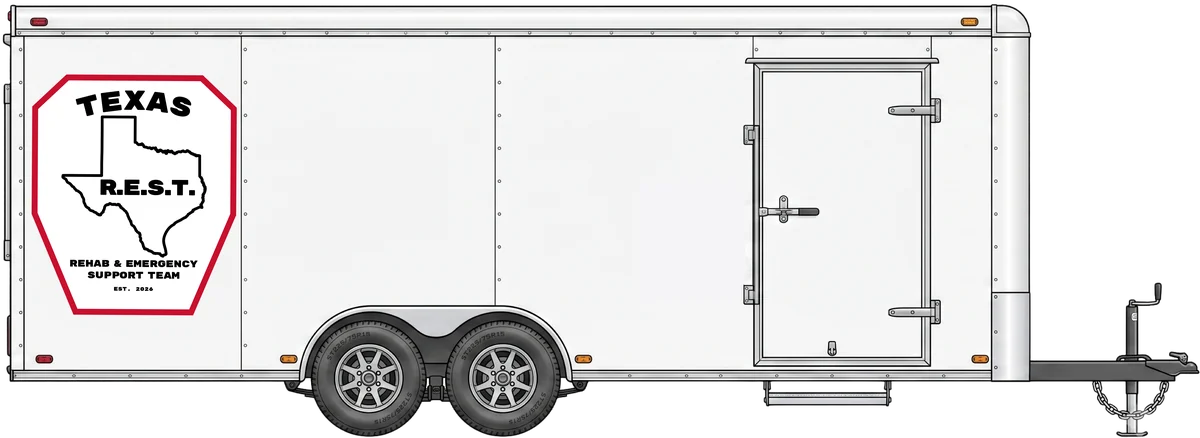
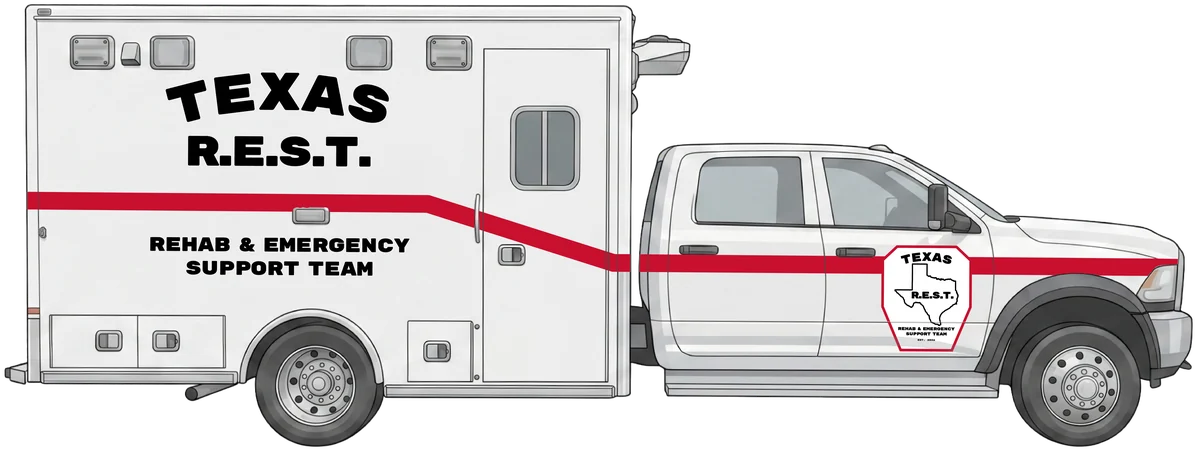
We’re actively building our fleet. Here’s what we roll with today and what’s on the way.
We can deploy anywhere in Texas for disasters and special assignments. What the map shows is where we can get there fast: the counties within reach of our staged equipment. That footprint grows with every agency agreement we put in place.
This map is a snapshot, not a boundary. We stage equipment where we have both the partnerships and the demand to support it, and each new agency agreement widens the area we can reach quickly. Counties get added as that happens.
Right now our assets are staged in Montgomery County, which puts the surrounding counties within quick reach. Everywhere else in Texas, we’re still a phone call away for disaster deployments, mutual aid, and special assignments. It just takes us longer to get there.
The shaded areas show how far a vehicle gets from that staging point in 30, 45 and 60 minutes, measured along real roads rather than as the crow flies. Each one takes in everything closer, so the ground we reach soonest sits under all three and reads darkest. They’re drawn at free-flow speeds, so treat them as our best case, not a promise: Houston traffic, weather, and the time it takes to get rolling all push the real number up. What they’re good for is the shape of the thing — which direction we reach furthest, and where the highways stop helping.
If your agency is outside the highlighted counties, that’s a conversation, not a no. Reach out and we’ll talk through what a response looks like for you.
Everywhere else in Texas: available by request for disaster deployment and special assignments.